

On November 30, 2022, one day after the United States survived the group stage at the FIFA World Cup in Qatar, a powerful conversational AI model named ChatGPT was officially released.
Few people realized then that football's old world and a new era of algorithms had quietly crossed paths.
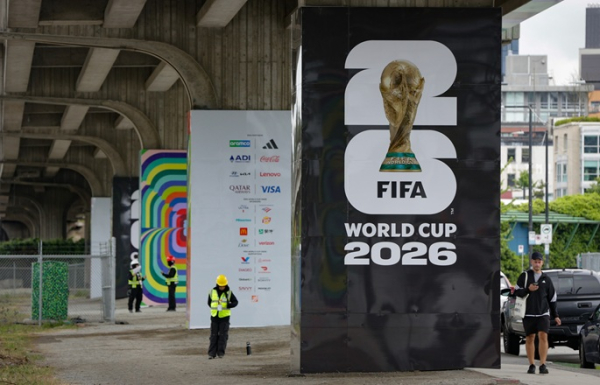
Four years on, the 2026 FIFA World Cup in the United States, Canada and Mexico is approaching. When codes begin talking about football, and algorithms start predicting champions, the sport's most attractive quality – its unpredictability – suddenly faces a direct challenge from artificial intelligence.
Before the tournament, Xinhua asked six leading AI models from China and abroad to predict the 2026 World Cup winner, and also interviewed experts from football and technology.
The discussion began with one simple question: Can AI really understand football?
WHY SPAIN?
The six models' answers were surprisingly similar: all chose Spain as the favorite to win the 2026 World Cup.
Their reasoning was also largely the same: Spain's Euro 2024 title, a 31-match unbeaten run, a new generation led by Lamine Yamal and Pedri, a defensive core built around Rodri, and what many models described as a relatively smooth path through the tournament.
Opta's supercomputer gave Spain a 17 percent chance of lifting the trophy, placing them clearly ahead in data-driven forecasts.
"From a pure probability perspective, Spain is indeed the safest choice at the moment," said Wang Jinqiao, a researcher at the Institute of Automation, Chinese Academy of Sciences, and an expert in large AI models.
But things became more interesting when DeepSeek and ChatGPT were asked to make a judgment "without relying on odds and historical data, but only on football knowledge."
Their answers changed.
France moved ahead of Spain, mainly because of Kylian Mbappe's individual brilliance, the team's deep squad, and its consistency in major tournaments after winning the 2018 World Cup and reaching the final in 2022.
"Large models are very obedient," Wang Jinqiao said. "If you ask them to look at data, they will return to historical records and probability models. If you ask them to put data aside, they will turn to softer narratives such as talent, mentality and even something like football fortune."
Wang Jinqiao does not see this shift as a flaw. On the contrary, it shows that AI can think in more than one way. The issue, he said, is that unlike humans, it cannot reliably combine these dimensions in a stable way and sometimes goes too far in one direction.
AI's ability to collect information is beyond doubt. But when it comes to real judgment, especially judgment about people, the gap is still clear.
"It is making probability-based reasoning in a creative way," Wang Jinqiao said. "In many cases, it reorganizes fragmented views from the internet in a smart and fluent way. You may call it a super information organizer, but it is still far from real comprehensive judgment, especially judgment about human feelings and social complexity."
Football experts share a similar view.
Ma Dexing, deputy editor-in-chief of Titan Sports, said AI prediction is more about searching and reorganizing information than making its own judgment.
"AI does not really have an independent understanding of football," Ma Dexing said.
Sports media professional Luo Yuan also raised concerns about the quality of information AI can use.
"There is less and less serious football reporting on the Chinese internet," Luo said. "The database that AI can search from already has many problems."
THE LUCK OF PAUL
The opening match of the 2026 World Cup will be held on June 11 at the Mexico City Stadium, where host Mexico will face South Africa.
By coincidence, it is the same matchup as the opening match of the 2010 World Cup in South Africa.
It was at that tournament that Paul the Octopus became one of the most famous "prophets" in football history, correctly predicting the results of eight matches in a row.
Sixteen years later, many people may ask: Can AI take over from Paul?
Experts are not unanimous.
"From a probability point of view, of course it is possible," said Wang Chao, head of Chaoyue Sports. "But it is still accidental."
Luo argued that even if AI got every result right, it would still be "a coincidence among coincidences."
The deeper problem is that the most important variables in football are often those AI cannot feel.
"The atmosphere in the dressing room, an argument between a player and a coach, a family emergency, or the mental pressure before a derby match — these subtle changes are things AI cannot perceive," Wang Jinqiao said.
Football media professional Ma Kexin said public AI models are still limited in real-time understanding of tactics and player form.
"They're good at processing expected goals, possession and other quantified data," Ma Kexin said. "But a team's form can change direction suddenly. Performance on the day is full of uncertainty."
Football commentator Yan Qiang used one English word to describe AI's blind spot: intangible.
"National temperament, the way one team matches up against another, and the psychological state of players in life-or-death matches – these are the real charming parts of football," Yan said.
Another question makes the limitations even clearer.
When Xinhua asked the AI models when China could return to the World Cup, the answers diverged widely.
Some models gave an optimistic prediction of around 2030. Some said China would need much more time to build youth training, reform the league and increase its football population. Others simply admitted that there was not enough certainty to make a prediction.
Compared with predicting the champion, a question that can rely heavily on historical data, discussing the future of Chinese football exposes AI's weakness in understanding complex social systems.
It can analyze tactics, but it cannot calculate the formation of a football culture. It can count population numbers, but it cannot predict a country's patience and passion for the sport.
PROBABILITY WITHOUT HEARTBEAT
Where will AI and football go from here?
One thing seems certain. Even if AI predictions become more accurate, people will still enjoy analyzing matches by themselves, listening to commentators argue, and discussing with friends late at night about who can win the World Cup.
"The value of human prediction is, in essence, emotional value," Ma Dexing said. "Fans build emotional connection during the process of discussion and prediction."
Yan believes humanized thinking may remain the biggest difference between AI and real people.
AI can give probability, but it cannot give heartbeat.
Experts have different views on the future role of AI in sports, but they agree on one point: AI will become more important, but it is unlikely to truly replace humans.
Yan said AI is far more efficient than humans in information collection, data organization and match simulation. But the final judgment should still be made by people.
"AI may become more human-like one day, and the human brain that predicts matches is also being made more rational by AI," Yan said. "The two may support each other in the future."
Wang Jinqiao described AI as a "super assistant."
"AI can be responsible for massive data mining and pattern recognition, while humans are responsible for experience, intuition and final decisions," Wang Jinqiao said. "Just like top teams are already doing. AI can help analyze corner-kick tactics, but when to make a substitution and when to take a risk still depends on the coach."
Ma Kexin said AI's biggest advantage is computing power, but what it lacks most is also what matters most in sport: emotion and resonance.
"If one day AI can predict every result with 100 percent accuracy, it will be the end of the sporting spirit," Wang Chao said.
Yan agreed. "If AI can calculate everything correctly, then sport itself will lose its meaning."
Football has never been a mathematical question.
It is accidental and full of emotion. The legend of Paul the Octopus was unforgettable not only because it predicted correctly, but also because it proved in another way that football can never be fully calculated.
That echoes the 2017 Go showdown between China's world champion Ke Jie and AlphaGo. After losing three games, Ke cried. But AI did not destroy Go – it opened a new world humans had never seen before.
Ke later said: "I believe the light of humanity will not disappear."
AI can tell you Spain's 17 percent chance of winning the World Cup, but it cannot tell you how many hearts will be moved if Lionel Messi and Cristiano Ronaldo pull on their national shirts for the last time.
It can run countless tactical models, but it cannot explain why underdogs, again and again, create miracles at the World Cup.
In the summer of 2026, when AI and football meet on the North American continent, what ultimately decides the matches may still be those things algorithms cannot define: inspiration on the grass, courage in desperate moments, and the never-extinguished passion of human beings.
- AI
- FIFA
- World cup
Source: www.dailyfinland.fi
